Lee Kuan Yew's Wills
Lee Kuan Yew's wills refers to the series of six wills — referred to as the First Will to Sixth Will — and one final "Last Will," executed by founding Prime Minister Lee Kuan Yew between 20 August 2011 and 17 December 2013, and the subsequent public and legal dispute over the circumstances in which the final version was prepared and signed.

This series followed an earlier, separate will Lee Kuan Yew had made in 1995 (see "The 1995 Will" below); "First Will" refers to the first of the 2011–2013 series, not the first will he ever made. The central point of contention is a clause, referred to in court proceedings as the "Demolition Clause," which appeared in some versions of the will and not others, and which stipulated Lee Kuan Yew's wish that his house at 38 Oxley Road be demolished after his death.
The dispute became public in June 2017 when Lee Kuan Yew's younger children, Lee Hsien Yang and Lee Wei Ling, accused their elder brother, Prime Minister Lee Hsien Loong, of abusing his position in connection with the house and the will. It subsequently produced a Ministerial Committee review, parliamentary debate, and disciplinary proceedings against the lawyer who prepared the final will, Lee Suet Fern.
This article sets out the documented content of each will and the findings made about them by the different bodies that have examined the matter, without adjudicating between the competing family accounts. Readers should note the distinction between two different things a court can do with a will: the Last Will was admitted to probate — the uncontested court process by which a will is accepted as authentic and used to administer an estate — on 6 October 2015, and this grant of probate has never been challenged or revoked by any party, including Lee Hsien Loong (see "The dispute becomes public" below).
What has never occurred is a contested probate action or other adversarial court proceeding in which a party sought to have the Last Will set aside as invalid — for example, on grounds of undue influence or lack of testamentary capacity. The only adjudicated proceedings to date have concerned the professional conduct of the lawyers involved in preparing the will, not a direct legal challenge to the will's validity or effect.
Background
Lee Kuan Yew had an earlier will dating from 7 December 1995 (see "The 1995 Will" below). His wife, Kwa Geok Choo, died in October 2010.
Following her death, Lee Kuan Yew began revising his testamentary arrangements, executing a series of six further wills between August 2011 and November 2012 — referred to on this page, and in most of the subsequent litigation, as the First Will (20 August 2011) through Sixth Will (2 November 2012); "First" here means the first of this post-2010 series, not the first will Lee Kuan Yew ever made.
Each of these six was prepared by his regular solicitor and niece, Kwa Kim Li, a partner at Lee & Lee. A final will, prepared with the involvement of his daughter-in-law, Lee Suet Fern (Lee Hsien Yang's wife, then a senior lawyer at Morgan Lewis Stamford), was signed on 17 December 2013, roughly 15 months before his death on 23 March 2015.
The 1995 Will
Lee Kuan Yew's will of 7 December 1995 named four executors and trustees: his three children — Lee Hsien Loong, Lee Wei Ling and Lee Hsien Yang — and his daughter-in-law, Ho Ching (Lee Hsien Loong's wife). Its residuary estate provisions held the property on trust for his wife, Kwa Geok Choo, for her life, with the estate passing to the three children in equal shares only after her death; it made no mention of 38 Oxley Road specifically and contained no demolition wish, reflecting that it predated both the family's later disputes over the House and Kwa Geok Choo's death in 2010.[1]
Lee Hsien Loong and Ho Ching were not retained as executors in any of the wills that followed. From the First Will (20 August 2011) onward, only Lee Wei Ling and Lee Hsien Yang were named executors and trustees; Lee Hsien Loong and Ho Ching do not appear in that role in any will after 1995.
Lee Kuan Yew's stated reason, in an email to Lee Hsien Loong on 23 July 2011, was that there "could be contention over 38 Oxley Rd."[2] This removal is separate from, and predates, the later dispute over the Demolition Clause's presence or absence in individual wills.
The First to Sixth Wills (2011–2012)
Between 20 August 2011 and 2 November 2012, Lee Kuan Yew executed six wills, referred to in subsequent legal proceedings as the First to Sixth Wills. Each was prepared by Kwa Kim Li. The key changes between them were as follows.[3]
| Will | Date | Estate division | Demolition Clause | Notes |
|---|---|---|---|---|
| First Will | 20 August 2011 | One-third share each to Lee Hsien Loong, Lee Wei Ling and Lee Hsien Yang | Present — house to be demolished on Lee Kuan Yew's death or after Lee Wei Ling moved out, whichever was later | 38 Oxley Road left to Lee Hsien Loong; Lee Wei Ling granted the right to reside there rent-free for as long as she desired; other properties left to Lee Hsien Yang; included a "Valuation Clause" requiring the Testator's properties to be valued as at the date of his death; Lee Hsien Loong and Ho Ching, executors under the 1995 Will, were not reappointed — only Lee Wei Ling and Lee Hsien Yang were named executors and trustees |
| Second Will | 21 December 2011 | Unchanged (one-third each) | Present | Lee Wei Ling's right to reside at 38 Oxley Road was removed |
| Third Will | 6 September 2012 | Lee Hsien Loong and Lee Hsien Yang each received three shares absolutely; Lee Wei Ling received four shares held on trust for her life, then to Lee Hsien Loong and Lee Hsien Yang equally | Present | |
| Fourth Will | 20 September 2012 | Reverted to one-third each (as in the Second Will) | Present | The Valuation Clause was removed |
| Fifth Will | 4 October 2012 | One-third each | Removed | Lee Wei Ling's right to reside at 38 Oxley Road was reinstated, but this time subject to Lee Hsien Loong's consent, and without the earlier "free of rent" wording |
| Sixth Will | 2 November 2012 | Seven shares total: Lee Hsien Loong and Lee Hsien Yang two shares each, Lee Wei Ling three shares | Absent (as in the Fifth Will) | In a 16 October 2012 email to Kwa Kim Li, Lee Kuan Yew explained his reasoning for departing from equal shares: "On reflection, I have decided to give more to Ling. The boys have higher incomes and also wives with big earnings." He initially proposed five shares (three to Lee Wei Ling, one each to Lee Hsien Loong and Lee Hsien Yang); Kwa Kim Li's handwritten note on the same email records this was "subsequently changed to" the 2:3:2 (seven-share) split reflected in the Sixth Will as executed.[4] |
It was not established in subsequent proceedings whether Lee Kuan Yew's children knew the precise contents of each of these six wills, though it was undisputed that all three were aware they were beneficiaries under each version.[3]
The Last Will (December 2013)
Deteriorating health and discussions with Kwa Kim Li
After the Sixth Will was executed in November 2012, Lee Kuan Yew's health deteriorated markedly; he was hospitalised for an extended period between September and October 2013. Beginning around 29 November 2013, he discussed possible changes to the Sixth Will with Kwa Kim Li, recorded in a series of emails.
The full text of Kwa Kim Li's email of 30 November 2013 [5]— addressed to Lee Kuan Yew as "Dear Uncle Harry" — survives and sets out the discussion in detail. She first recapped the Sixth Will's distribution (38 Oxley Road to Lee Hsien Loong, other properties to Lee Hsien Yang, a valuation clause to equalise the shares in cash).
She then recorded that Lee Kuan Yew had raised, in a discussion the previous night, "the possibility that Oxley may one day be 'de-gazetted' after your passing," which would cause the property's value to "escalate" — and that his "sentiment is that if there is de-gazetting after your passing, and the property value escalates, then you would like Ling and Yang to benefit from the increased value, as this would only be fair," since the House would otherwise remain solely in Lee Hsien Loong's name at the higher value.[6]
Kwa Kim Li set out three options for Lee Kuan Yew to consider: (1) keep the Sixth Will's distribution, but add a clause requiring Lee Hsien Loong to pay Lee Wei Ling and Lee Hsien Yang a share of any value increase if the House was later de-gazetted, within a set time frame; (2) leave the House to the three children jointly, letting them decide on valuation, development and de-gazetting among themselves — which she said was "not ideal" given her experience that joint ownership often causes friction, but was "probably the 'fairest' way because all 3 children will [have] equal shares in Oxley and in the upside"; or (3) some other arrangement. She asked Lee Kuan Yew to "let me know your thoughts, and I can make the appropriate changes to the Will."[6]
In a 12 December 2013 email, Kwa Kim Li noted his wish that, unlike the Sixth Will, Lee Wei Ling should not be left with more shares than her brothers. Lee Kuan Yew replied at 10.50pm on 13 December 2013, a Friday. As at that date, three days before he received a further draft, the plan discussed with Kwa Kim Li was for her to prepare a codicil to the Sixth Will — there had been no discussion of replacing the Sixth Will altogether or of reinstating the Demolition Clause.[3]
16–17 December 2013
On 16 December 2013, Lee Suet Fern sent Lee Kuan Yew an email at 7:08pm attaching a draft will (the "Draft Last Will") and describing it as "the original agreed Will," referring to the First Will of 19/20 August 2011. Lee Suet Fern later said she believed at the time that the draft was the same as the First Will. In fact, the Draft Last Will differed from the First Will in several respects, including:
- the Oxley Maintenance clause — the First Will had provided that Lee Hsien Loong would pay for the maintenance and upkeep of 38 Oxley Road while Lee Wei Ling was in occupation; this was absent from the Draft Last Will; and
- the Gift-Over clause — the First Will had specific provisions for what would happen to a child's share if that child predeceased Lee Kuan Yew; the Draft Last Will had no equivalent clause.[7]
The precise origin of the Draft Last Will was not established in the disciplinary proceedings; the court found only that it appeared similar to, but was not identical to, the First Will, and that its exact provenance was not proven on the evidence.[3]
Later that evening, Lee Kuan Yew's private secretary sent a message recording his intention to "go back to [the] 2011 will." Lee Hsien Yang arrived in Singapore (having been in Brisbane) on the morning of 17 December 2013, and the will — described in the document itself as an "Execution Copy" — was signed by Lee Kuan Yew that day, witnessed by two individuals.[3]
Content of the Last Will
The Last Will, as executed on 17 December 2013, provided, among other things:[8]
- Lee Wei Ling and Lee Hsien Yang were appointed executors and trustees.
- 38 Oxley Road was left to Lee Hsien Loong (or a company or trust of which he is a settlor, beneficiary, or beneficial owner), "subject to the condition that my daughter, [Lee Wei Ling], shall be allowed to continue to live there for so long as she desires."
- Lee Kuan Yew's shares in Kwa Geok Choo Private Limited were left to Lee Wei Ling.
- Three properties were left to Lee Hsien Yang.
- The residuary estate was divided so that, after accounting for the value of the properties bequeathed above, the three children would receive equal shares.
- Clause 7 restored the Demolition Clause: "I further declare that it is my wish, and the wish of my late wife, [Kwa Geok Choo], that our house at 38 Oxley Road … ('the House') be demolished immediately after my death or, if my daughter, [Lee Wei Ling], would prefer to continue living in the original house, immediately after she moves out of the House. I would ask each of my children to ensure our wishes with respect to the demolition of the House be carried out. If our children are unable to demolish the House as a result of any changes in the law, rules or regulations binding them, it is my wish that the House never be opened to others except my children, their families and descendants. My view on this has been made public before and remains unchanged."
Comparing the Last Will against the First Will, the disciplinary tribunal and the Court of Three Judges found there were "significant" differences between the two documents, even though Lee Kuan Yew had been told, and appears to have believed, that he was simply reverting to the 2011 original.[3]

Contemporaneous correspondence, 2010–2013

Much of what is publicly known about the sequence of events comes from family email correspondence disclosed years later in litigation — principally in the Lee Suet Fern disciplinary proceedings and in Lee Hsien Loong v Xu Yuan Chen, where Xu, as a defendant relying on a defence of justification, adduced a chronology of emails obtained from Lee Hsien Yang and Lee Wei Ling, and Lee Hsien Loong separately gave his own account in evidence. The two accounts of what the correspondence shows differ; both are set out below, with the High Court's eventual findings on the disputed points noted where relevant.
What is not disputed. The High Court in Lee Hsien Loong v Xu Yuan Chen recorded that "[p]arties do not dispute that around September 2012 at the very latest, [Lee Kuan Yew] had been under a misimpression that the House had been gazetted," citing a 6 September 2012 email from Lee Kuan Yew to Kwa Kim Li stating: "Although [the House] has been gazetted as a Heritage house it is still mine as owner."[9]
What the parties disputed was why and by whom that impression had been created, and whether it was Lee Hsien Loong who caused it.
Xu's pleaded chronology (drawn from his Affidavit of Evidence-in-Chief, exhibits TX-15 to TX-34) set out the following sequence:
- 27 October 2010 — Lee Kuan Yew issued a memo to the Cabinet stating that 38 Oxley Road "should not be kept as a kind of relic for people to tramp through" and asked that his wish for demolition after his death be respected.
- 18 March 2011 — an email chain among Lee Kuan Yew and government and media contacts, in which he stated he had decided demolition was best.
- 20 July 2011 — a further memo to Cabinet reiterating the demolition wish.
- 21 July 2011 — at Lee Hsien Loong's request, Lee Kuan Yew met the Cabinet to discuss the House; no minutes were taken.
- 23 July 2011 — Lee Kuan Yew emailed Lee Hsien Loong stating he had left him out as an executor as there "could be contention over 38 Oxley Rd."
- 15–17 August 2011 — an email chain titled "Gazetting Oxley," from which Lee Hsien Loong was excluded, in which Lee Kuan Yew discussed with the rest of the family how to draft the will so that the Cabinet "could not get their way" with the House; he instructed Kwa Kim Li to prepare the will based on wording finalised by Lee Suet Fern. In cross-examination during the Xu Yuan Chen trial, Kwa Kim Li confirmed that her handwritten notes on a 17 August 2011 email from Lee Suet Fern to Lee Kuan Yew (copied to Lee Hsien Yang and Lee Wei Ling) included "certain words and language" that were "subsequently inserted into" the First Will, signed three days later — indicating Lee Suet Fern's involvement in the wording of the will predates the December 2013 dispute by more than two years.[10]
- 18 August 2011 — when Kwa Kim Li asked to discuss the will's details, Lee Kuan Yew told her to refer to Lee Suet Fern, "as she knows."
- 20 August 2011 — the First Will was signed.
- 3 October 2011 — Lee Kuan Yew wrote to Ho Ching (copying his children) that Lee Hsien Loong had indicated he would, as Prime Minister, declare the House a heritage site.
- 27 December 2011 — Lee Kuan Yew wrote to Cabinet that its members were unanimously against demolition.
- 6 September 2012 — Lee Kuan Yew emailed Kwa Kim Li and Lee Wei Ling (subject line "Osley," sic), stating: "Although it has been gazetted as a Heritage house it is still mine as owner. But I cannot alter the basic structure of the house. And the cabinet has opposed tearing it down and rebuilding, because 2 PMs have lived in the house, me and Loong. But the house is still mine and I can in my will give Ling the right to stay on in the house." Kwa Kim Li added a handwritten note on the email — "I can't find gazette. Told him." — which she confirmed under cross-examination in the Xu Yuan Chen trial referred to Lee Kuan Yew.[10]
- 2 October 2012 — a further email from Kwa Kim Li to Lee Kuan Yew, on which she made handwritten notes reading "Lee Hsien Loong has free rein" and "He can handle Cabinet." Under cross-examination, Kwa Kim Li confirmed both notes referred to Lee Hsien Loong, though she initially declined to answer on grounds of privilege before the trial judge, Audrey Lim J, directed her to.[10] Kwa Kim Li testified she searched for a record of the gazetting on at least two separate occasions — once via her firm's librarian around 6 September 2012, and again via a colleague "perhaps a few days after" — and could not recall whether either search preceded or followed the 6 September email.[10]
- 16 October 2012 — Lee Kuan Yew emailed Kwa Kim Li setting out his revised thinking on the share division (see the Sixth Will row above); on the same email, Kwa Kim Li wrote "I can't find Oxley gazette," which she confirmed in court meant she could not find any document showing the House had been gazetted. Around this period Lee Kuan Yew instructed her to prepare the Fifth Will, removing the Demolition Clause and giving Lee Hsien Loong "free reign" over the property so that he would take the "hit and the heat" — the "hit" being the reduced property value from the (believed) gazetting, and the "heat" being Cabinet pressure.[10]
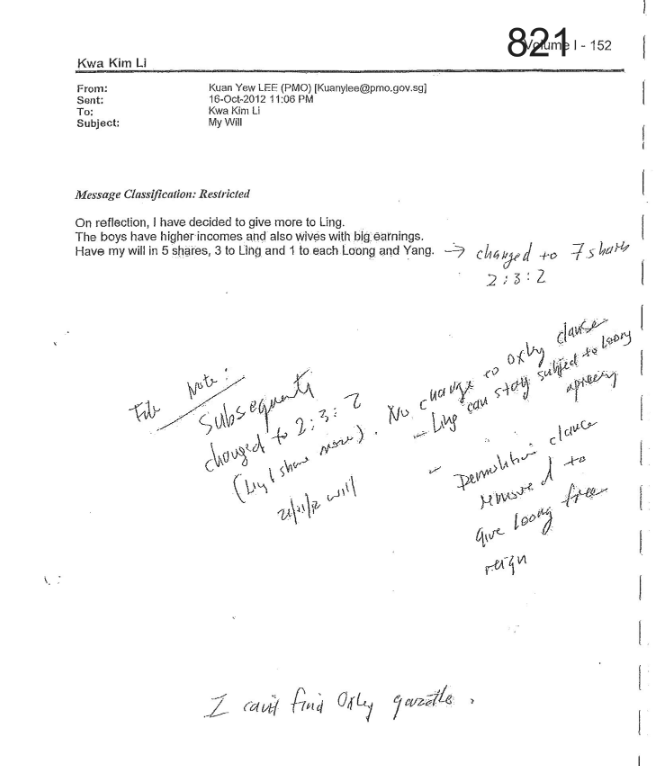
Email from Lee Kuan Yew to Kwa Kim Li (handwritten notes from Kwa)

- 30 November 2013 — Kwa Kim Li's email to Lee Kuan Yew (see "Deteriorating health and discussions with Kwa Kim Li" above) in which she recorded his wish that Lee Wei Ling and Lee Hsien Yang share in any increase in the House's value if it were later "de-gazetted," and set out options for achieving this, including giving the House to all three children equally.[6]
- 17 December 2013 — the Last Will, reinstating the Demolition Clause, was signed.
On this basis, Xu's pleaded case was that only Lee Hsien Loong, as Prime Minister, could have been the source of Lee Kuan Yew's mistaken belief that the House had been or would be gazetted, since Kwa Kim Li had told him the opposite on at least two occasions.[2]
Lee Hsien Loong's evidence, which the High Court ultimately accepted, was that he had supported his father's wish to demolish the House and had proposed, from as early as March–July 2011, that any proceeds from redeveloping the site be donated rather than kept by the family; that he had told his father only that Cabinet was likely to insist on gazetting if the matter came before it formally, not that gazetting had occurred; and that he was recused from the Cabinet's internal deliberations on the House because of his personal conflict of interest.
The court found that Lee Hsien Loong had "no reason to mislead" his father and that the documentary record — including a 14 August 2011 email in which Lee Kuan Yew told the family "Will [the House] to [Lee Hsien Loong]" and his own 11 August 2011 and 3 October 2011 emails describing gazetting as Cabinet's likely position rather than a settled fact — was more consistent with Lee Kuan Yew having assumed gazetting was the probable outcome, not having been told it had already happened.[9]
The court also found no evidence that Lee Kuan Yew was told in "late 2013" that the House had not been gazetted (an allegation in the article at the centre of that suit); the correction, to the extent one occurred, was Kwa Kim Li's advice given in 2012.[9]
Xu's account also drew on a 29 July 2011 email from Lee Wei Ling to then-Minister for Home Affairs and Law K Shanmugam, describing Lee Kuan Yew's belief that Lee Hsien Loong had asked him to speak to Cabinet so that Cabinet could tell him it wanted the House preserved, and recording that Lee Kuan Yew planned to meet Shanmugam together with Lee Hsien Yang and Lee Wei Ling to decide how to draft the will provisions on the House.[2] This episode does not appear to have been separately adjudicated.
Sale of the house within the family (2015)
After inheriting the house under Lee Kuan Yew's will, Lee Hsien Loong first offered to sell it to Lee Wei Ling for a nominal S$1, on condition that any future sale proceeds, if the Government later acquired the property, be donated to charity; she declined. Lee Hsien Yang then purchased the house from his brother at market valuation, on the agreed condition that each of them would donate half the sale value to charity; Lee Hsien Loong later said he donated the entirety of his own share. Lee Wei Ling later disputed the accuracy of her brother's public statements about the terms of this arrangement.
The dispute becomes public (2017)
The existence of disagreements within the family over the will and the house remained private until June 2017, when Lee Hsien Yang and Lee Wei Ling issued a joint public statement accusing Lee Hsien Loong of misusing his position and influence as Prime Minister to advance his own preferences regarding 38 Oxley Road, and of "deliberately misrepresenting" their father's wishes. They also raised concerns about the political influence of Lee Hsien Loong's wife, Ho Ching, and said they felt "big brother [was] omnipresent."[11]
In the same 14 June 2017 statement, Lee Hsien Yang and Lee Wei Ling addressed the Last Will directly, asserting that it reflected their father's — and their late mother's — genuine and consistent wish that the House be demolished, and that this had been settled by probate:
In 2015, various letters were sent by Hsien Loong's then personal lawyer making accusations and misrepresentations on his behalf regarding the circumstances under which Lee Kuan Yew's last will was executed and the inclusion of the demolition wish. These were refuted in detail by us through our lawyers. Hsien Loong knew that he could not establish his accusations in a court of law and raised no legal challenge. On the contrary, he was likely concerned that the fact that the gift of the house to him had been obtained by him through misrepresentations to our father and the family might be made public. Probate was granted on 6 October 2015 and Lee Kuan Yew's will, including the wish to demolish 38 Oxley Road, became the full, final, and legally binding word on his intentions as to his estate.[12]
The Last Will was accordingly admitted to probate on 6 October 2015 — a date not contested by any party in the subsequent disputes.[12] Probate confirms that the document was accepted by the court as Lee Kuan Yew's valid last will and testament for the purposes of administering his estate; it is a separate question from whether any solicitor involved in preparing it met their professional obligations, which is what the Lee Suet Fern disciplinary proceedings later examined (see below).
Lee Hsien Yang and Lee Wei Ling have consistently maintained, both in the June 2017 statement and in subsequent public statements, that the Demolition Clause reflected their father's and their late mother Kwa Geok Choo's genuine and settled wishes, and that no party — including Lee Hsien Loong — ever mounted a legal challenge to the will or the Demolition Clause's validity.
The same 14 June 2017 statement identified the lawyer behind the 2015 letters referred to above as Lucien Wong, at the time Lee Hsien Loong's personal lawyer, who was appointed Attorney-General of Singapore on 14 January 2017 — a role in which he continued to serve while the dispute was public.
According to the statement, Lee Hsien Yang and Lee Wei Ling had executed a Deed of Gift with the National Heritage Board in 2015 to donate items from 38 Oxley Road for public exhibition, stipulating that Lee Kuan Yew's demolition wish be displayed prominently; after the gift was accepted, they said they received letters raising "spurious objections" from Wong, and separately said Lee Hsien Loong had obtained a copy of the Deed of Gift from then-Minister for National Development Lawrence Wong and passed it to Lucien Wong "to advance his personal agenda."
The same letters, they said, also disputed the circumstances of the Last Will's execution and the inclusion of the Demolition Clause, which they said they refuted through their own lawyers.[12] Wong's dual role — having acted for Lee Hsien Loong on these matters before being appointed the Government's chief legal officer — was raised by opposition politicians in 2017 as a conflict-of-interest concern (see "Attorney-General's Chambers" below).
Parliamentary statements
Lee Hsien Loong addressed the allegations in two Ministerial Statements to Parliament, "Alleged Abuse of Power on 38 Oxley Road[13]" (3 July 2017) and a closing statement the following day. He denied the allegations of abuse of power, and stated that no Member of Parliament had produced or substantiated further allegations against him or the Government beyond what had already been raised.[14][15]
Following the parliamentary sitting, Lee Hsien Loong recused himself from all Cabinet and Government decisions relating to 38 Oxley Road, with Deputy Prime Minister Teo Chee Hean taking charge of the matter; his only subsequent dealings with the Ministerial Committee (see below) were formal written responses to its requests, on the same basis as his siblings' dealings with the Committee.[15]
The Ministerial Committee
A Ministerial Committee on 38 Oxley Road, chaired by DPM Teo Chee Hean, was convened following the 2017 dispute. Its mandate was limited to considering options for the physical fate of the house — ranging from full preservation to demolition and redevelopment — and it did not make findings on the validity of the will or on which family member's account of events was correct. See 38 Oxley Road for the Committee's options and eventual outcome.
Attorney-General's Chambers
Questions were separately raised in 2017 about whether the Attorney-General's Chambers, then headed by Attorney-General Lucien Wong, could impartially examine the abuse-of-power allegations.
Wong had been Lee Hsien Loong's personal lawyer and, on Lee Hsien Yang and Lee Wei Ling's account, had acted for him on the 2015 correspondence disputing the Deed of Gift and the circumstances of the Last Will (see above), before being appointed Deputy Attorney-General in December 2016 and Attorney-General in January 2017.
Opposition figures, including the Singapore Democratic Party, called for Wong's removal on this basis[16].
No public findings on the substance of the will dispute were issued by the AGC; the Government's position was that the Attorney-General's prior professional connection to Lee Hsien Loong had been disclosed to the President and that recusal, where relevant, was the appropriate safeguard rather than removal from office.
Disciplinary proceedings against Lee Suet Fern
The Law Society of Singapore brought disciplinary proceedings against Lee Suet Fern arising from her role in preparing and overseeing the execution of the Last Will. In November 2020, the Court of Three Judges found her guilty of misconduct unbefitting an advocate and solicitor and suspended her from practice for 15 months.[3]
The court's findings included that she had acted for Lee Kuan Yew in preparing his Last Will while she had a personal interest in its contents (her husband, Lee Hsien Yang, was a beneficiary), that she had represented the Draft Last Will to Lee Kuan Yew as being the same as his First Will when it was not, and that she had not taken steps to ensure Lee Kuan Yew received independent legal advice on the changes being made, given his age and the significance of the document.
The court did not find, and was not asked to determine, that Lee Kuan Yew lacked testamentary capacity or that he was coerced into signing the Last Will; the finding was confined to the standard of professional conduct expected of the solicitor involved, not the validity of the will itself.
A subsequent independent opinion by Timothy Dutton QC, commissioned in connection with the disciplinary proceedings, concluded that aspects of the Court of Three Judges' reasoning were "flawed" and disagreed with specific aspects of how the court characterised Lee Suet Fern's conflict of interest — see Law Society of Singapore v Lee Suet Fern for the full account of that opinion.
Disciplinary proceedings against Kwa Kim Li
Kwa Kim Li — the solicitor for the First to Sixth Wills, though not the solicitor who drafted the Last Will itself — was separately the subject of disciplinary proceedings (DT 19 of 2022) arising from a complaint by Lee Hsien Yang and Lee Wei Ling.
While Kwa Kim Li was not the drafting solicitor for the Last Will, the proceedings concerned her own communications with Lee Kuan Yew in the period immediately preceding it: she had exchanged emails with him between 29 November and 13 December 2013 — discussing possible changes to the Sixth Will, shortly before Lee Suet Fern's 16 December 2013 email set the Last Will's execution in motion (see "The Last Will" above) — and the charges concerned two later emails, dated 4 June and 22 June 2015, in which she responded to queries from the executors (Lee Hsien Loong, Lee Wei Ling and Lee Hsien Yang) about the will's history.
Two sets of charges resulted. The first, brought by the Law Society, concerned confidentiality: Kwa Kim Li admitted that her 4 June 2015 email disclosed confidential information — copies of five earlier wills and email correspondence with Lee Kuan Yew — to Lee Hsien Loong without the executors' consent. The Disciplinary Tribunal found this to be low-culpability, low-harm misconduct and imposed a $5,000 penalty.
The second, brought directly by Lee Hsien Yang as complainant, alleged that Kwa Kim Li's letters misled the executors by omitting her November–December 2013 communications with Lee Kuan Yew and by falsely stating that she had received no instructions from him to change the Sixth Will.
The Disciplinary Tribunal found, specifically in relation to the 22 June 2015 email, that the omission of the November/December 2013 emails was misleading and that her statement that she had received no instructions to change the will was false — but found no proof beyond reasonable doubt that this was done knowingly or deliberately, attributing it instead to a lack of due care and diligence.
It imposed a further $8,000 penalty, bringing her total penalty to $13,000. The Tribunal accepted Lee Hsien Yang's evidence that the omission "caused unnecessary doubt and confusion about what prompted [Lee Kuan Yew] to change his 2 November 2012 Will," and assessed harm as low and culpability as low to medium.[17]
See Law Society of Singapore v Kwa Kim Li for full detail on the proceedings.
Related proceedings and developments
- Lee Hsien Loong v Xu Yuan Chen — a 2019–2021 defamation suit brought by Lee Hsien Loong against The Online Citizen's chief editor over an article repeating the siblings' allegations about the gazetting dispute and the will; the High Court's findings on the gazetting timeline are a primary source for this article (see "Contemporaneous correspondence" above).
- Li Shengwu contempt of court case — arose from a private, later-leaked Facebook post by Lee Kuan Yew's grandson Li Shengwu (Lee Hsien Yang's son) criticising the Singapore courts, made in the context of the family's dispute over the will and house.
- Police investigation into Lee Hsien Yang and Lee Suet Fern — a police investigation, disclosed in Parliament in March 2023, into whether Lee Hsien Yang and Lee Suet Fern gave false evidence in the disciplinary proceedings described above. Both were later granted political refugee status by the United Kingdom, announced in October 2024.
- 38 Oxley Road — the property itself, its architectural and heritage history, and its eventual acquisition and gazetting as a National Monument.
See also
References
- ↑ Last Will of Lee Kuan Yew, executed 7 December 1995, cll 1, 4.
- ↑ 2.0 2.1 2.2 Affidavit of Evidence-in-Chief of Xu Yuan Chen, Lee Hsien Loong v Xu Yuan Chen, HC/S 882/2019, affirmed November 2020, at [34](k), exhibit "TX-23".
- ↑ 3.0 3.1 3.2 3.3 3.4 3.5 3.6 Law Society of Singapore v Lee Suet Fern [2020] SGHC 255, at [5]–[6].
- ↑ Email from Lee Kuan Yew to Kwa Kim Li, "My Will," 16 October 2012.
- ↑ https://media.politicalsg.com/media/Kwa_email_to_LKY_2013.pdf
- ↑ 6.0 6.1 6.2 Email from Kwa Kim Li to Lee Kuan Yew, "your question on the properties in your name," 30 November 2013.
- ↑ Law Society of Singapore v Lee Suet Fern [2020] SGHC 255, at [15].
- ↑ Last Will and Testament of Lee Kuan Yew, executed 17 December 2013 ("Execution Copy"), cll 4(a), 7.
- ↑ 9.0 9.1 9.2 Lee Hsien Loong v Xu Yuan Chen and another suit [2021] SGHC 206, at [4].
- ↑ 10.0 10.1 10.2 10.3 10.4 "Defamation trial: LKY's lawyer Kwa Kim Li's handwritten notes reveal PM Lee Hsien Loong 'has free rein', 'can handle Cabinet'", The Online Citizen, 3 December 2020.
- ↑ "Singapore Prime Minister Lee Hsien Loong publicly denounced by siblings", CNN, 14 June 2017.
- ↑ 12.0 12.1 12.2 Lee Hsien Yang and Lee Wei Ling, joint statement "What has happened to Lee Kuan Yew's values?", 14 June 2017.
- ↑ https://www.pmo.gov.sg/newsroom/ministerial-statement-pm-lee-hsien-loong-alleged-abuse-power-38-oxley-road/
- ↑ "Ministerial Statement by PM Lee Hsien Loong on 'Alleged Abuse of Power on 38 Oxley Road'", Prime Minister's Office Singapore, 3 July 2017.
- ↑ 15.0 15.1 "Closing Statement by PM Lee Hsien Loong on the Ministerial Statements on 38 Oxley Road", Prime Minister's Office Singapore, 4 July 2017.
- ↑ https://www.theonlinecitizen.com/2017/07/25/sdp-urges-president-tony-tan-to-revoke-lucien-wongs-appointment-as-attorney-general
- ↑ Report of the Disciplinary Tribunal, In the matter of Kwa Kim Li, DT 19 of 2022, 5 May 2023.